בידספיריט | נכס Carlyle T. Heroes and the | 29/11/2020 | The Arc
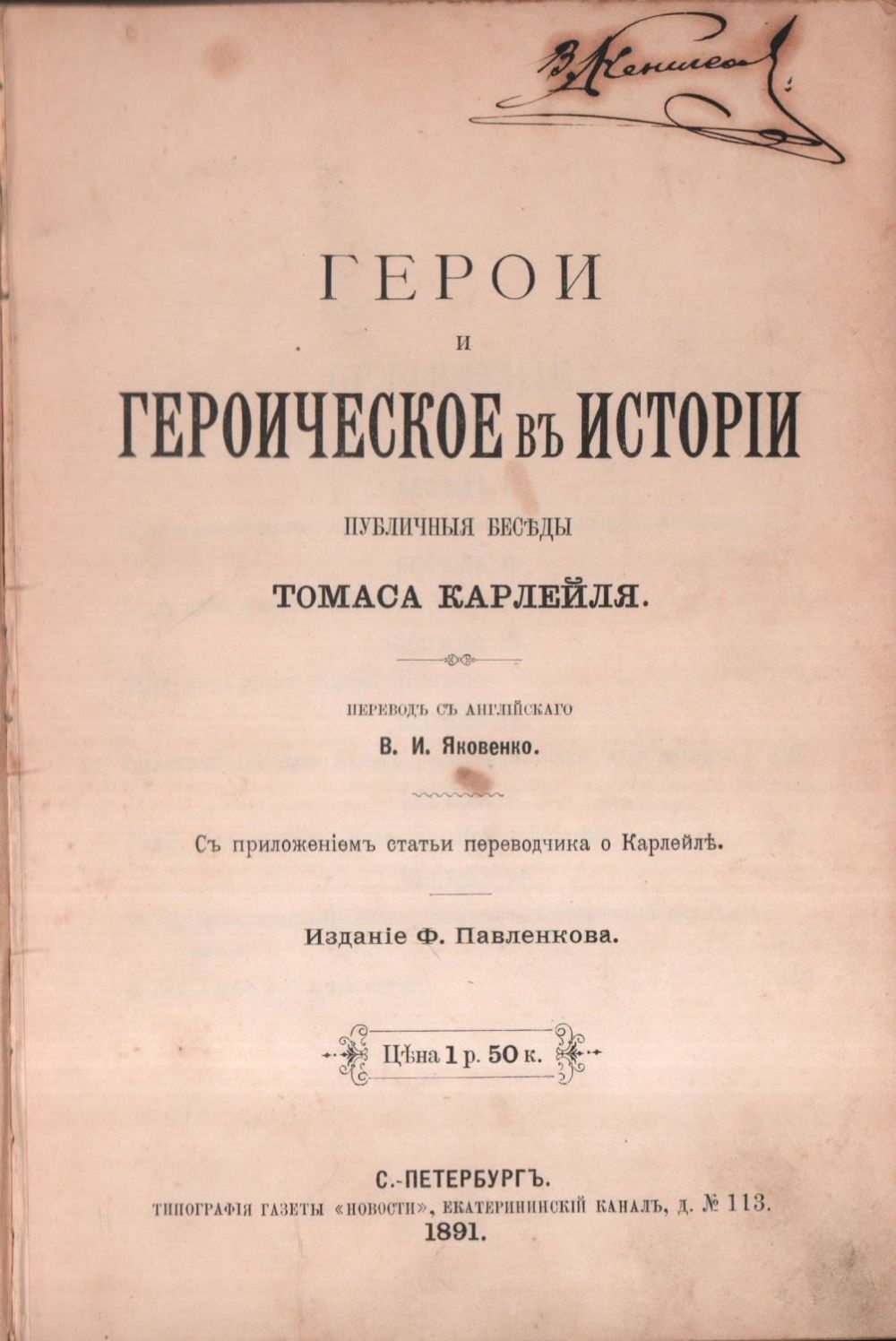
Carlyle T. Heroes and the heroic in history. Public conversations. - First edition in Russian. St. Petersburg Edition F. Pavlenkova 1891 352 pHardcover, 20 x 13 cm. Condition: Good, scuffed binding, spine, pasted 336 pages, notes in the text. Thomas Carlyle (also known as Carlyle, 1795-1881) was a British writer, essayist, historian and philosopher of Scottish origin, author of the multi-volume works ”the French revolution” (1837), ”Heroes, hero worship and the heroic in history” (1841), ”History of the life of Frederick II of Prussia” (1858-65). He professed a romantic ”cult of heroes” - exceptional personalities like Napoleon, who by their actions fulfill the divine destiny and move humanity forward, towering above the crowd of limited inhabitants. He is also known as one of the most brilliant stylists of the Victorian era. Born into a simple peasant family; destined by his strict Calvinist parents for a spiritual career, he entered the University of Edinburgh at the age of 14. Not wanting to be a priest, he became a mathematics teacher in the provinces after completing his University course, but soon returned to Edinburgh. Here, living on an occasional literary income, he spent some time working hard at law, preparing for the bar; but this, too, he quickly abandoned, becoming interested in German literature. Goethe's translation of Wilhelm Meister in 1824 and Schiller's Life in 1825 were Carlyle's first major works. These were followed by critical reviews and translations from Jean-Paul. ”A prophetic sorrow as deep as Dante's, ”disguised in the” Sunny and refined Goethe, ” Carlyle considered accessible only to a few mortals. He gave a course of lectures on German literature, in 1838 on European literature, and in 1839 on ”the Revolution in modern Europe”. The last time I read the course was in 1840. This was the only published and therefore extant course on the role of the hero in history. The list of heroes itself: Dante, Shakespeare, Luther, Rousseau, Napoleon, Cromwell, etc. These lectures brought Carlyle some income, and after 1840 He no longer needed money and was rarely encouraged to speak. The philosophical novel Sartor Resartus was published by Carlyle in 1833-1834 in parts in Fraser's Magazine, but was initially received critically and did not bring the author the desired fame. The first complete edition of the novel was published first in the United States in 1836, where it was very popular. Later, in 1838, on the wave of interest in Caleyl after the publication of ”History of the French revolution”, an English edition appeared. It is believed that the book marked the beginning of Victorian romanticism. The same originality as these works is distinguished by the ” History of the French revolution ”(”French Revolution, a history”, 1837), the caustic pamphlet ”Chartism” (1839), lectures on heroes and the heroic in history (”on Hero worship”, 1841) and historical and philosophical reflections ”Past and present” (1843). Not being a member of any established political party, Carlyle felt lonely and thought for a while about publishing his own magazine to preach his ”religious radicalism”. All these works of Carlyle are imbued with the desire to reduce the progress of mankind to the lives of individual outstanding personalities-heroes (according to Carlyle, world history is a biography of great people, see the Theory of great people), to put the basis of civilization exclusively moral duty; his political program is limited to the preaching of work, moral feeling and faith. An exaggerated appreciation of the heroic in history and a distrust of the power of institutions and knowledge led him to a formal cult of past times more favorable to heroic people. His views are more pronounced than anywhere else in the twelve” Latter-day pamphlets ”(”Latter-day pamphlets”, 1858); here he laughs at the emancipation of the Negroes, at democracy, philanthropy, political and economic doctrines, etc. Not only did the former enemies resent Carlyle after these pamphlets, but many of his admirers ceased to understand him. Throughout the 1840s, Carlyle's views shifted towards conservatism. Gradually, Carlyle's criticism of capitalism became more and more muffled, and his statements against the popular masses became more and more harsh. In the book ”Before and now”, he drew idyllic pictures of medieval society, where supposedly simple noble morals reigned, a good monarch ensured the welfare and freedom of his subjects, and the Church cared about high moral values. It was a romantic utopia that brought Carlyle closer to the feudal socialists. Of all Carlyle's writings, Letters and Speeches of Oliver Cromwell (1845-46), with commentaries, is of the greatest historical significance; the latter are far from impartial to the ”hero” Cromwell. Carlyle showed in a new way the role of Cromwell in the history of the country, in particular,